


If you like what we are doing

-
Just out
- Following currents
- Athena the Weaver
- Worldwide
- Every story is ours
- Of Sacrifice and Snowdrops
- A thrilling journey
- Silent Night, Holy Night
- Appeal to eternity
- W.A. Mozart: Regina Coeli in C major, K. 276
- A wondrous comet appeared…
- The Oratorio of Joy
- Christmas Concerto
- For the first Sunday in Advent…
- Be joyful…
- Energy medicine : The Whole Story
What is new

Listening to Orpheus

Make New from Old

Featured

What is hot

What is cool

What is apropos

Come on in…
What we are talking about
Archives
When & what
March 2026 M T W T F S S 1 2 3 4 5 6 7 8 9 10 11 12 13 14 15 16 17 18 19 20 21 22 23 24 25 26 27 28 29 30 31 To the backroom
-
Join 227 other subscribers
Will & Wants
 The spiritual path is inherently about letting go of desires and wants of any kind That which I think will make me happy – but even more so of that which prevents me from being fulfilled right now.
Adyashanti: The Falling Away of Personal Will
Eckhart Tolle: Is There Such a Thing as Free Will ?
Posted in Teacher & Teachings
5 Comments
Conventional wisdom
By PAUL KRUGMAN
 Earlier this week, the Federal Reserve Bank of New York published a blog post about the “mistake of 1937,” the premature fiscal and monetary pullback that aborted an ongoing economic recovery and prolonged the Great Depression. As Gauti Eggertsson, the post’s author (with whom I have done research) points out, economic conditions today — with output growing, some prices rising, but unemployment still very high — bear a strong resemblance to those in 1936-37. So are modern policy makers going to make the same mistake?
Mr. Eggertsson says no, that economists now know better. But I disagree. In fact, in important ways we have already repeated the mistake of 1937. Call it the mistake of 2010: a “pivot” away from jobs to other concerns, whose wrongheadedness has been highlighted by recent economic data.
To be sure, things could be worse — and there’s a strong chance that they will, indeed, get worse.
Back when the original 2009 Obama stimulus was enacted, some of us warned that it was both too small and too short-lived. In particular, the effects of the stimulus would start fading out in 2010 — and given the fact that financial crises are usually followed by prolonged slumps, it was unlikely that the economy would have a vigorous self-sustaining recovery under way by then.
By the beginning of 2010, it was already obvious that these concerns had been justified. Yet somehow an overwhelming consensus emerged among policy makers and pundits that nothing more should be done to create jobs, that, on the contrary, there should be a turn toward fiscal austerity.
Water

By By EDWARD WONG
A chronic drought is ravaging farmland. The Gobi Desert is inching south. The Yellow River, the so-called birthplace of Chinese civilization, is so polluted it can no longer supply drinking water. The rapid growth of megacities — 22 million people in Beijing and 12 million in Tianjin alone — has drained underground aquifers that took millenniums to fill.
Not atypically, the Chinese government has a grand and expensive solution: Divert at least six trillion gallons of water each year hundreds of miles from the other great Chinese river, the Yangtze, to slake the thirst of the north China plain and its 440 million people.
The engineering feat, called the South-North Water Diversion Project, is China’s most ambitious attempt to subjugate nature. It would be like channeling water from the Mississippi River to meet the drinking needs of Boston, New York and Washington. Its $62 billion price tag is twice that of the Three Gorges Dam, which is the world’s largest hydroelectric project. And not unlike that project, which Chinese officials last month admitted had “urgent problems,” the water diversion scheme is increasingly mired in concerns about its cost, its environmental impact and the sacrifices poor people in the provinces are told to make for those in richer cities.
Nights in Spanish Gardens
Beauty and Perfection
Manuel de Falla: Nights in Spanish Gardens
Daniel Barenboim and the Vienna Philharmonic Orchestra
Live Concert 2009
Posted in Classical Music
Leave a comment
A grotesque abdication of responsibility
Unemployment is a terrible scourge across much of the Western world. Almost 14 million Americans are jobless, and millions more are stuck with part-time work or jobs that fail to use their skills. Some European countries have it even worse: 21 percent of Spanish workers are unemployed.
Nor is the situation showing rapid improvement. This is a continuing tragedy, and in a rational world bringing an end to this tragedy would be our top economic priority.
Yet a strange thing has happened to policy discussion: on both sides of the Atlantic, a consensus has emerged among movers and shakers that nothing can or should be done about jobs. Instead of a determination to do something about the ongoing suffering and economic waste, one sees a proliferation of excuses for inaction, garbed in the language of wisdom and responsibility.
A Spanish Tahrir
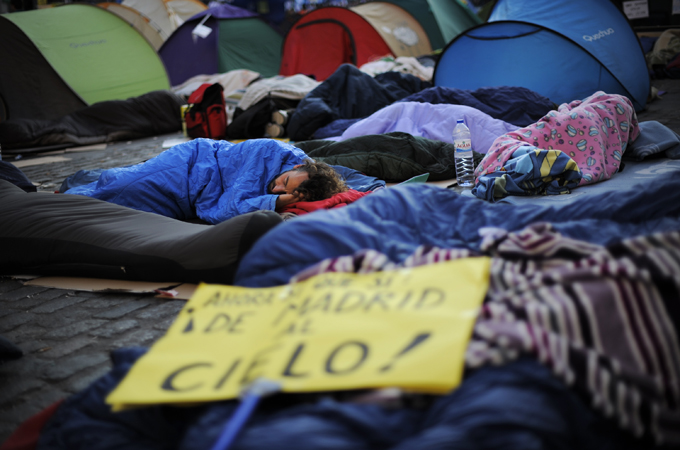
High unemployment and a belief that politicians focus more on profit than people sparked youth protests across Spain. They have organised a peaceful occupation of Plaza del Sol against unemployment and corruption among politicians.
” Real Democracy Now” movement
By Daniel F Rivera
Anger, irritation, annoyance and even rage are some of the most common adjectives used by protestors camping atPlaza del Sol in Madrid.
The massive series of demonstrations that started on May 15 gathered people from all classes and ages. Mothers came with their children; professors and lawyers gave improvised speeches at every corner of the plaza, protesters started building tents and other facilities.
The 15M movement or “Real Democracy Now – DYR” – started as a public outcry denouncing political corruption and unemployment that has soared to unprecedented levels. Some 25 per cent of the labour force can’t find a job and almost 50 per cent of young people are unemployed.
They united against what they see as an outrageous situation produced by bankers and politicians.
Nerea, an active demonstrator with some physical disabilities, put it this way: “Right now we have political corruption, banks that are abusing our people, there is not access to housing and we can’t find proper jobs. I’m a graphic designer and I’m studying advertising and the only job the administration offers me is to become a teleoperator.”
Nerea’s views are just one of many similar claims that we find among protesters in Madrid, Barcelona, Seville, Valencia and other major cities. People also began to demonstrate in front of the Spanish embassies in Berlin, New York, Egypt and Ecuador.
Joan, a Spanish demonstrator, protesting in front of the Spanish Embassy in Quito, Ecuador, commented: “This is not a demonstration against the socialist government of Rodriguez Zapatero. The problem is that democracy does not care about the interests of the people anymore. Powerful people, banks and corporations have sneaked between us and the politicians.”
God knows where I am
 A griping article about a patient who rejects her diagnosis, refused all psychiatric medication and drifted to the edge of society.
A world of regions
By Jeffery D Sachs
America’s failure to win any lasting geopolitical advantage through the use of military force in Iraq and Afghanistan underscore the limits of its power,
In almost every part of the world, long-festering problems can be solved through closer cooperation among neighboring countries. The European Union provides the best model for how neighbors that have long fought each other can come together for mutual benefit. Ironically, today’s decline in American global power may lead to more effective regional cooperation.
This may seem an odd time to praise the EU, given the economic crises in Greece, Spain, Portugal, and Ireland. Europe has not solved the problem of balancing the interests of strong economies in the North and those of weaker economies in the South. Still, the EU’s accomplishments vastly outweigh its current difficulties.
The EU has created a zone of peace where once there was relentless war. It has provided the institutional framework for reuniting Western and Eastern Europe. It has fostered regional-scale infrastructure. The single market has been crucial to making Europe one of the most prosperous places on the planet. And the EU has been a global leader on environmental sustainability.
For these reasons, the EU provides a unique model for other regions that remain stuck in a mire of conflict, poverty, lack of infrastructure, and environmental crisis. New regional organisations, such as the African Union, look to the EU as a role model for regional problem-solving and integration. Yet, to this day, most regional groupings remain too weak to solve their members’ pressing problems.









 The Living Room