Don’t take the emotions too seriously. If you’re not aware, you can lose in them easily.
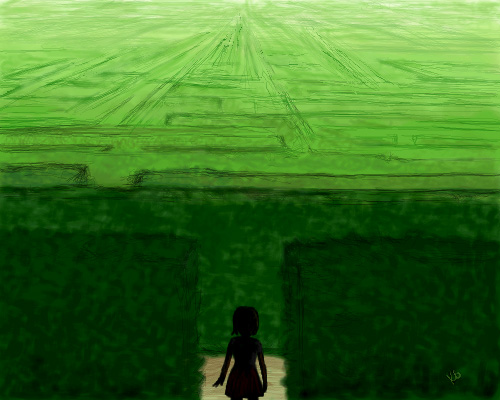
With thinking you’re making problems, not solving them.
Don’t take the emotions too seriously. If you’re not aware, you can lose in them easily.
With thinking you’re making problems, not solving them.
 Is arthritis really about feeling unloved, as I read in Louise Hay’s book “You Can Heal Your Life” ? I didn’t know at the time but the debilitating pain of arthritis taught me surrender, courage, acceptance, patience ~ and much more.
I can pinpoint a specific occasion as the trigger or “final straw” which led deep into a chasm of sadness that I thought I’d expressed fully, but clearly hadn’t. I then contracted into resistance, to begin life in a body that felt like it was turning inside-out.
Pain came on gradually over a period of weeks. At first I thought a new bed was to blame for my aching stiff joints. Gradually, especially at night, a creeping agony would bind my limbs, fingers, toes and jaw. Like Cinderella at the stroke of midnight, when out and about I felt afraid I wouldn’t be able to get home before my body locked up solid.

Feeling indignant despair that years of yoga and tai chi were seemingly wasted, I questioned ~ do I even know my own body ? This pain felt much deeper than a physical ailment. At the time I hadn’t read Eckhart Tolle or heard of a “painbody.”
Stubborn about treatment, and not wanting to add toxins to an already struggling system, I took a long solitary and silent route, without anti-inflammatory drugs. Ignoring all advice from GP, family and friends ~ knowing it was what I had to do ~ to hear the calls from deep inside.
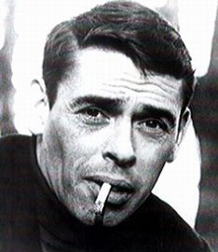 Came across Jaques Brel and his beautiful and soulful chansons.
I have all but forgotten about him…
He sung through the heart, he lived his songs.
Enjoy
 “Peace I leave with you; My peace I give to you; not as the world gives, do I give to you. Let not your heart be troubled, nor let it be fearful. (John 14:27)
Jesus said: “People think, perhaps, that I have come to throw peace upon the world. They don’t know that I have come to throw disagreement upon this world, and fire, and sword and struggle. ” (The Gospel of Thomas, 16a)
Isn’t this a perfect example of the difference between a direct and an indirect teaching ? I am fascinated by Jesus the teacher, and the fiery acuteness of his message. There is no doubt of what he is talking about. Think of the gentle words and mild manners of modern day’s prophets. Teachers go with their time and perhaps also with the readiness of their audience to really listen to this message, be receptive, take it in and let the seed grow. Did any of Jesus’ disciples get it ? How much clearer, immediate and more direct can anyone speak of what is true, than the Prince of Peace.
So what does he say: Follow me, look at me, trust me. Open your heart, let nothing of this world trouble you – and find the kingdom of heaven in you, the peace that is not of this world but is this world. And then, in his direct teachings, he is so clear, so immediate, relentlessly revealing that this peace requires a questioning of everything we believe to be true (disagreement), a complete transformation (fire), by the sword (cutting through the illusion of duality, standing for protection and destruction) and the personal choices of non-comformity that have to be taken every day to live by what is true.
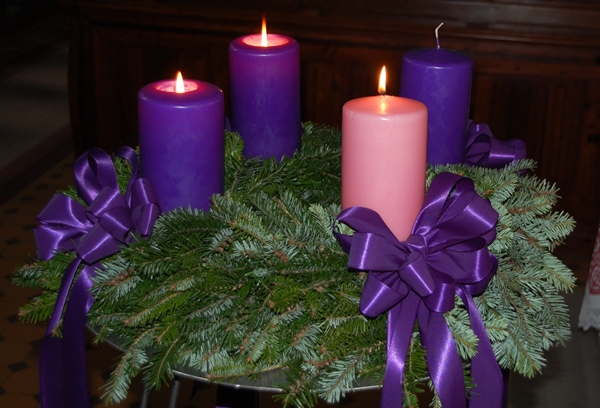 The advent wreath is a tradition in my country. Puprple is the classic color for three of the four Sundays of Advent: once the color associated with royalty, it symbolizes Christ as the “Prince of Peace.” Rose is the color for the Third Sunday of Advent, known as Gaudete Sunday from the Latin word “rejoice.”
It is custom to lit the candles in the late afternoon, eating stollen and singing Christmas carols. Today all four candles were lit.
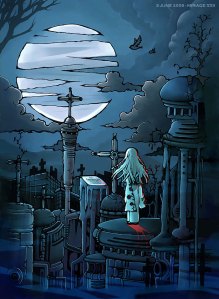
You can’t face the future. You can only face the Now and the thought in your mind about the imagined future, what is in the Now too.
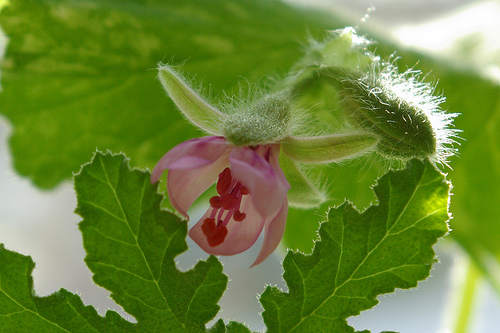
Colour of the heart chakra
More and more I am becoming aware of the various levels of our being and how everything is connected. This is also true for the development of symptoms and disease.
From a holistic perspective, the origin of a disease cannot be seen in isolation. There are many reasons that may contribute to an energetic imbalance that signifies the original disturbance leading to the development of a disease. These reasons include, but are not limited to, genetic susceptibility, environment, toxins, unhealthy lifestyle choices and all the other little things we do, that put our physical body under a strain.
To understand the aetiology (factors that contribute to a disease), as well as the causation ( primary reason for the disturbance), is important in terms of dealing with health challenges, that are so much more than a nuisance or bad luck – they are literally wake-up calls, that may point to underlying issues that need to be addressed in the course of ceasing to live with lies and illusions.
Christmas—that magic blanket that wraps itself about us, that something so intangible that it is like a fragrance. It may weave a spell of nostalgia. Christmas may be a day of feasting, or of prayer, but always it will be a day of remembrance, a day in which we think of everything we have ever loved. ~Augusta Rundel
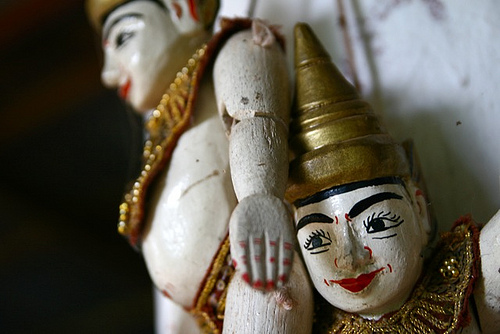 When we speak of addiction, we also have to investigate co-dependency.
Addicted people often have a counter part – another person, who is the enabler and who is involuntarily, but ver effectively doing everything to keep the addicted person at his or her habit. This is difficult to understand, if you have not made the experience of being co-dependent yourself, or have watched someone close to you in such a relationship.
Co-dependency is not unusual. We are all co-dependent to some degree, as we are all connected and locked in the world of opposites. This is the victim – offender analogy and it means that in each victim, there is an offender and in each offender, there is a victim. We are all related and often attracted to the very personality traits, that we have to develop ourselves.
 Can you imagine anything more enchanting?
From the ballet:
The Nutcracker
by P. I. Tchaikovsky









 The Living Room