Some more angelic creatures as perceived by the ” imagician” Giotto Bondone…


Hark ! the herald angel sings
Some more angelic creatures as perceived by the ” imagician” Giotto Bondone…
Hark ! the herald angel sings
This is Giotto’s beautiful Ognissanto Madonna, originally painted for a Franciscan church in Florence. The Italian title of the painting is “La Maestà di Ognissanti”, pointing to the the majestic quality of the logos or wisdom, giving birth to everything.
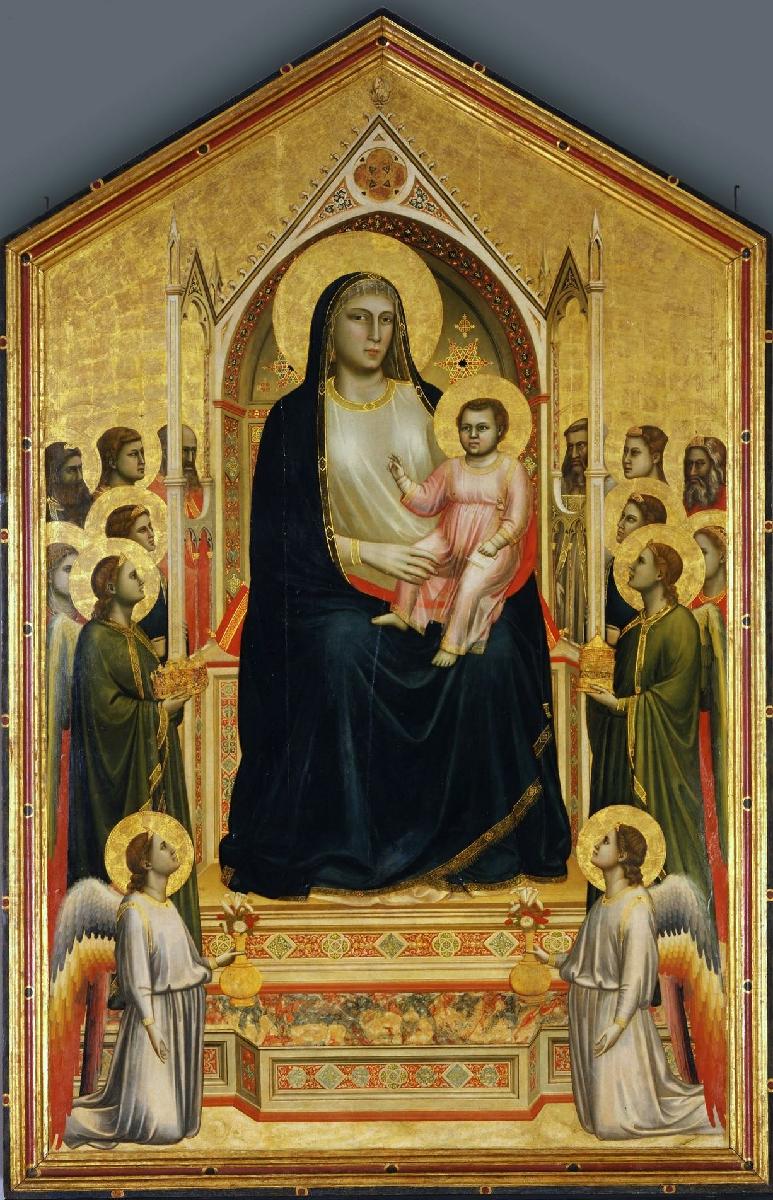
Giotto Ognissanti Madonna ca 1310 Galleria Uffici, Florence
Friends on the path came together yet once again. This time they meet at the dawn of the anxiously anticipated Dec 21, 2012, a day rife with prophecies, colourful expectations and an unusually intense planetary alignment. The “end of the world” is a familiar place on the spiritual path and so the topic of this friendly get together was surrender or ” The beginning of the end”.
Moderator: Ray
Enjoy.
PS: The youtube video may be blocked in Germany due to the Billie Holiday tune. If that happens, please use this link: http://vimeo.com/56160535
This is one of the altar pieces of the Parish Church St Wolfgang, Austria. The artist is Michael Pacher (ca 1430 – 1498) and this beautiful scene is complemented with a traditional Christmas carol from the area. Its a shepherd’s song in a local dialect. “Heissa” means something in between hurray and let’s go, an expression of joy and enthusiasm.
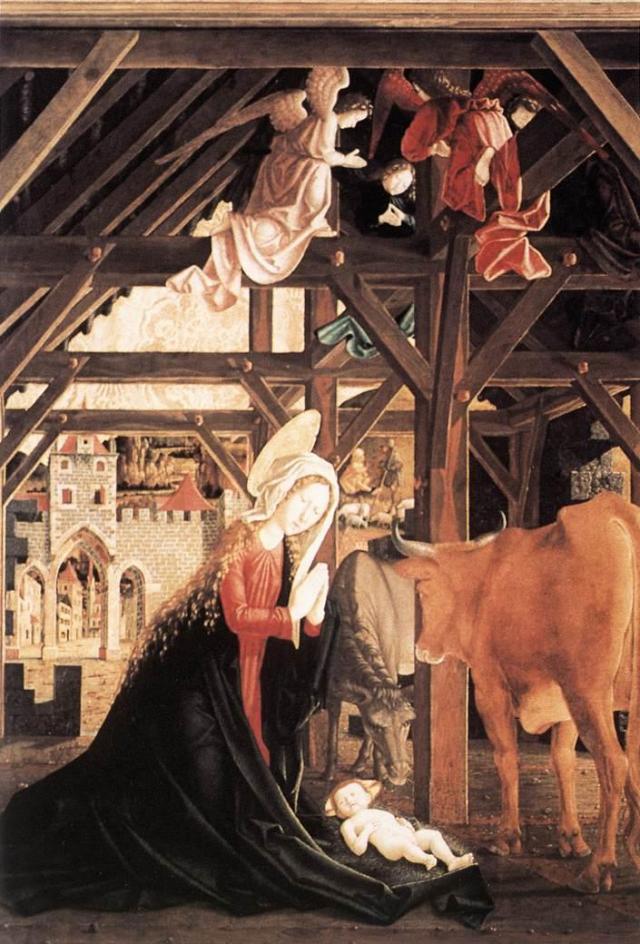
Michael Pacher Nativity St Wolfgang
Heissa
This is Giotto’s Last Judgement. Just look at it and see what this is all about. Fire and brimstone, the purification of the soul and the alchemical reaction.
Here is the traditional interpretation:
The top part shows Heaven, with Jesus in the middle and the apostles at both sides. Jesus is casting the Last Judgment. The lower part shows the chosen, who will be escorted to Heaven, and the doomed, who will be cast into Hell. The archangels Michael and Raphael are holding the cross in the middle.
But I much rather view it as this:
Brimstone stands for (alchemical) sulphur, which represents the spirit of life. So what we are looking it is the Christ ( represented by Jesus), casting out the demons with the fire (of spirit), by taking them on. Not fight them, but bring it into the light. We see the cross, which signifies the spiritual path of surrender. ” God so loved the world that he gave his only son”. The two angels represent healing (Raphael) and battle (Michael), leading God’s army against the Satan.
It is possible that Dante, the great Renaissance poet and an acquaintance of Giotto’s, was inspired by this depiction of Hell when he wrote Inferno.

Giotto ” Last Judgement” ca 1306
This is a detail from a ceiling fresco in Vienna – angels bringing the Christ Child from the heavenly father to the earth.
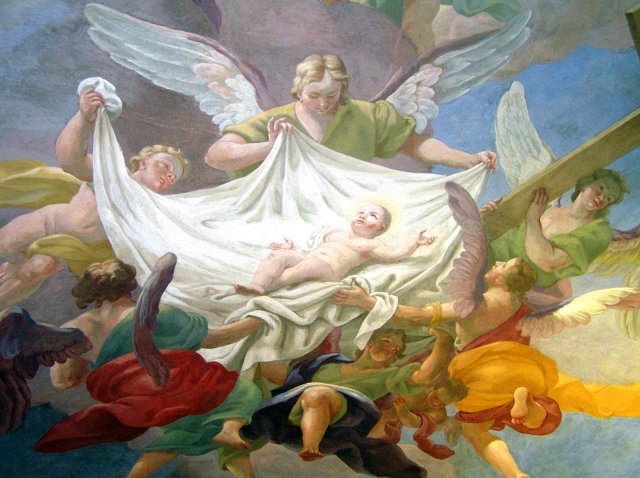
The Glory of the new born Christ Child, ca 1715, Ceiling fresco – St Anna, Vienna
And this is one of my favorites. …a carol traditionally sung in churches at the nativity
Schlaf, schlaf, schlaf,
Mein liebes Kindlein, schlaf!
Die Engel tun schön musizieren,
Bei dem Kindlein jubilieren.
Schlaf, schlaf, schlaf,
Mein liebes Kindlein, schlaf!
Groß, groß, groß
Die Lieb’ ist übergroß
Gott hat den Himmelsthron verlassen
Und muss reisen auf der Straßen.
Groß, groß, groß,
Die Lieb’ ist übergroß.
Here is another Giotto angel. Rather elegant and composed…
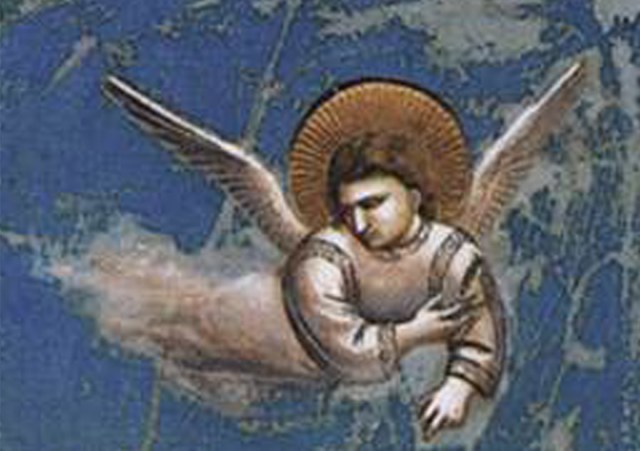
Giotto – Flight into Egypt (detail) ca 1306; Scrovegni (Arena) Chapel, Padua, Italy
A Giotto angel…one of his wondrous, birdlike creatures. Maybe this is how people saw them in the early 14th century ?

Giotto ca 1305; from the Dream of Joachim, Scrovegni (Arena) Chapel, Padua, Italy
Refrain
Gloria, in excelsis Deo!
Shepherds, why this jubilee?
Why your gladsome strains prolong?
Say what may the tidings be
Which inspire your heavenly song?
Refrain
Come to Bethlehem, come and see
Whose birth the angels sing;
Come, adore on bended knee,
Christ the Lord, the newborn King.
Refrain
Another nativity by the visionary Giotto.- This one, from the early 1300 is clearly showing the advent from the traditional Byzantine treatment to features of the early Renaissance. The nativity is a scene from a fresco in Assisi. Nobody painted angels like Giotto. They are almost bird-like creatures and in a way – very human.
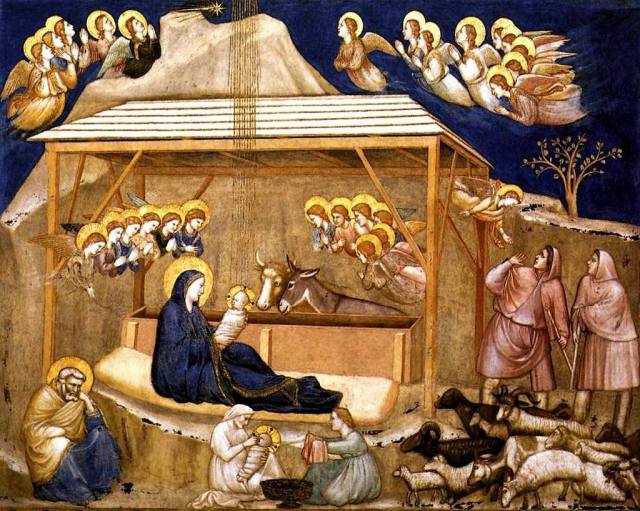
Giotto, ca 1310; Fresco North transept, Lower Church, San Francesco, Assisi
Refrain
Jesus your King is born,
Jesus is born,
In excelsis gloria.
Within a lodge of broken bark
The tender babe was found,
A ragged robe of rabbit skin
Enwrapped His beauty round;
But as the hunter braves drew nigh,
The angel song rang loud and high:
Refrain
The earliest moon of wintertime
Is not so round and fair
As was the ring of glory on
The helpless Infant there.
The chiefs from far before Him knelt
With gifts of fox and beaver pelt.
Refrain
O children of the forest free,
O seed of Manitou,
The holy Child of earth and Heav’n
Is born today for you.
Come kneel before the radiant Boy,
Who brings you beauty, peace and joy.
Refrain
Walt Whitman. The humanist expressing the unified view.
Click for full text
I Celebrate myself, and sing myself,
And what I assume you shall assume,
For every atom belonging to me as good belongs to you.
I loafe and invite my soul,
I lean and loafe at my ease observing a spear of summer grass.
My tongue, every atom of my blood, form’d from this soil,
this air,
Born here of parents born here from parents the same, and
their parents the same,
I, now thirty-seven years old in perfect health begin,
Hoping to cease not till death.









 The Living Room